The $2M-$10M Peril: Why Most Startups Fail to Scale GTM
By Charles Sword
Most startup failures aren't technology failures. They're go-to-market failures. And they almost always happen in the same place: the race from $2M to $10M in ARR.
This is where the math stops working. Where overhead explodes. Where the bet you made on your GTM model either pays off spectacularly or destroys your runway. The companies that survive this gauntlet look brilliant. The ones that don't blame "market conditions" or "product-market fit." But the real culprit is almost always the same: they spent too much, too early, on the wrong GTM structure.
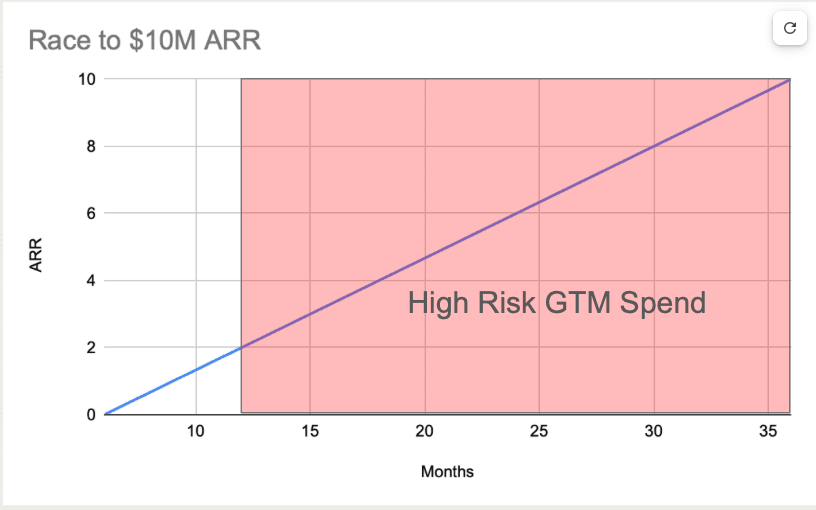
The danger zone: High-risk GTM spend dominates the critical $2M-$10M growth phase
The Danger Zone
Here's the fundamental problem. In the earliest days — getting to your first $2M in ARR — you can get away with scrappy, founder-led sales and minimal overhead. A couple of AEs, maybe a BDR, some marketing spend. The efficiency isn't great, but the absolute dollars are manageable. You're not trying to be profitable; you're trying to prove you have something.
But once you cross $2M and start the push toward $10M, everything changes. Suddenly you need:
- A proper sales organization with managers, enablement, and process
- A real marketing function that can generate predictable pipeline
- Customer success to reduce churn and drive expansion
- Solutions engineers to handle technical sales cycles
- Revenue operations to keep it all running
The classic playbook says: hire a CRO at $180-240K, build out a full GTM team, and spend $1.5M in base salaries to manage $2M in recurring revenue. That's a 75% overhead ratio before you add commissions, marketing spend, or tooling. You're burning cash at a terrifying rate, and you won't see ROI for 12-18 months — if the model works at all.
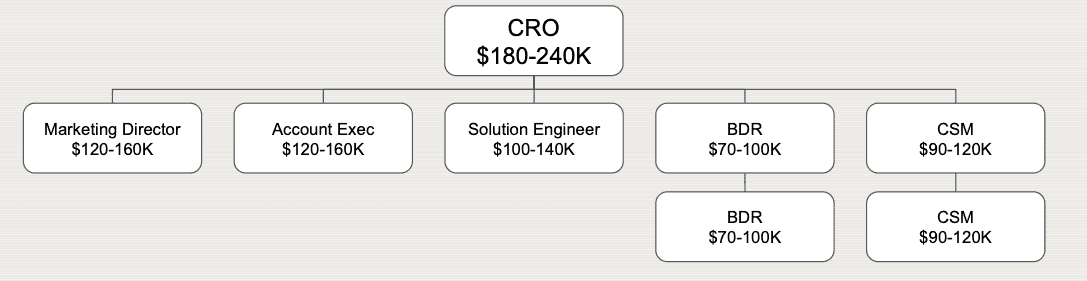
The classic GTM structure: $1.5M in base salaries to manage $2M in ARR
This is the danger zone. Most startups yield poor returns on early GTM spend because they're essentially guessing. They hire the "classic" GTM structure because that's what worked at their investors' other portfolio companies. But every market is different. Every product is different. And if you guess wrong, you've just burned 18 months of runway building a machine that doesn't work.
The Overhead Trap
The brutal reality is that overhead is disproportionately high in the $2M-$10M window. You need experienced GTM leaders, but you don't yet have the revenue to support them. You need functional specialization — product marketing, demand gen, sales development, customer success — but you can't afford full teams in each area.
So you either:
- Hire too lean and fail to build momentum (slow death)
- Hire the full "classic" structure and run out of money before proving the model (fast death)
- Hire a mismatched team that's the wrong fit for your GTM motion (expensive death)
Time spent in this danger zone is the critical factor. The longer you're there with unproven unit economics, the more capital you burn. The more capital you burn without clear progress, the harder the next fundraise becomes. Investors start asking hard questions about CAC payback and sales efficiency, and you don't have good answers because you're still experimenting.
Post-$10M: When The Model Proves Out
Here's the other side of the story. Once you get past $10M in ARR, the math starts to balance. If you've built a GTM model that works, scale becomes your friend. The overhead that felt crushing at $3M in ARR becomes proportional at $15M. The systems and processes you put in place start driving repeatable, predictable growth.
The CRO who cost you 12% of revenue at $2M now costs you 1.5% at $15M. The BDR-to-AE ratios start working. The marketing spend starts converting at known rates. Customer success becomes a profit center through expansion revenue. You go from firefighting to optimization.
But you only get there if you survive the danger zone. And survival requires a fundamentally different approach to how you staff, scale, and structure GTM in those critical early years.
The AI-First Alternative
This is where the landscape has fundamentally shifted — and where most startups are still operating with a 2019 playbook in a 2025 world.
AI and fractional GTM staffing have changed the economics of scaling from $2M to $10M in three profound ways:

The AI-first model: $500K in base spend vs. $1.5M, with 1.5-2x productivity gains
1. Proportional Overhead Instead of Fixed Costs
The classic model requires hiring full-time senior GTM leaders upfront — before you know if the model works. A CRO at $180-240K. A VP Marketing at $160-200K. Directors of Sales, Customer Success, Revenue Operations. You're paying for full-time talent to figure out what might work.
The AI-first model flips this. You start with a fractional CRO at $60K who brings senior strategic expertise without the full-time cost. You use AI-powered tools to do the work that used to require three marketing specialists. You bring in fractional GTM talent — account executives, BDRs, solution engineers — who scale up and down with your actual pipeline needs, not your hiring plan.
Instead of $1.5M in base GTM salaries to chase $2M in ARR, you're at $500K. Same strategic firepower. Same ability to execute. But the overhead is proportional to where you actually are, not where you hope to be in 18 months.
2. 1.5-2x Productivity Through AI Leverage
The second unlock is productivity. AI doesn't just reduce headcount — it fundamentally changes what's possible with the same number of people.
A single fractional marketing director with the right AI stack can now do what used to require a full team:
- AI-powered content generation for blogs, case studies, ad copy, and email sequences
- Automated audience segmentation and personalization at scale
- Predictive lead scoring using AI models trained on your best customers
- AI-assisted campaign optimization that runs multivariate tests continuously
The same applies to sales. AI tools now handle meeting notes, follow-up sequencing, competitive intelligence research, and deal analysis. A BDR with AI-powered prospecting and outreach can cover 2x the territory. An AE with AI-generated call prep and proposal drafting can manage 1.5x the pipeline.
This isn't about replacing humans. It's about amplifying them. You're getting 1.5-2x the output per dollar of GTM spend because your people are focused on high-judgment work — strategy, relationship-building, closing — while AI handles the repetitive, data-intensive, and process-driven tasks.
3. Faster, Cheaper Iteration
The real killer in the danger zone isn't the absolute cost of GTM. It's the cost of being wrong.
If you hire a full GTM team and the model doesn't work, you've burned 12-18 months and $2-3M figuring that out. Then you have to reset — new hires, new strategy, new burn rate — and you've lost half your runway.
The AI-first, fractional model lets you iterate faster and cheaper. You can test different GTM motions — inbound vs. outbound, PLG vs. sales-led, vertical focus vs. horizontal — without committing to full teams. You bring in fractional talent with specific expertise, use AI to accelerate execution, and learn what works in 90 days instead of 9 months.
When something doesn't work, you pivot without layoffs, without destroying morale, and without explaining to your board why you need another $5M to try again.
The New Math
Let's compare the two models side by side.
Classic GTM Structure ($2M → $10M ARR):
- $1.5M in base GTM salaries
- $1M in ARR quota per GTM FTE (initial efficiency)
- $2M in recurring revenue managed by the team
- 18-24 months to prove the model works
- High risk if the GTM bet is wrong
AI-First, Fractional GTM Structure ($2M → $10M ARR):
- $500K in fractional GTM talent and AI tools
- $1.5M in ARR quota per person (AI-enhanced productivity)
- Same $2M in recurring revenue managed
- 6-12 months to iterate and optimize
- Lower risk, faster learning cycles
Same revenue target. One-third the overhead. Faster iteration. And here's the critical part: once you prove the model works and you get to $10M ARR, many of these fractional roles can be brought in-house. The AI tools and workflows you've built become force multipliers for your full-time team. You're not starting from scratch — you're scaling what already works.
Why This Matters Now
This isn't a theoretical future. This is happening right now, and it's creating a massive advantage for startups that figure it out early.
The companies building with AI-first GTM from day one are reaching $10M in ARR with half the capital, half the team size, and twice the learning velocity of their peers. They're not constrained by the classic playbook. They're not burning 18 months to find out their GTM model doesn't work.
They're lean, they're fast, and they're capital-efficient in the most dangerous part of the startup journey.
The $2M-$10M window will always be hard. The pressure to scale, the investor expectations, the market dynamics — none of that changes. But the tools, the talent model, and the economics have fundamentally shifted. The startups that recognize this have a structural advantage. The ones still hiring like it's 2019 are fighting with one hand tied behind their back.
The danger zone hasn't disappeared. But for the first time, there's a way to cross it without betting the company.
Charles Sword is the founder of Work Different, a GTM advisory practice helping B2B technology companies navigate the changing landscape of go-to-market strategy, AI-powered growth, and capital-efficient scaling.